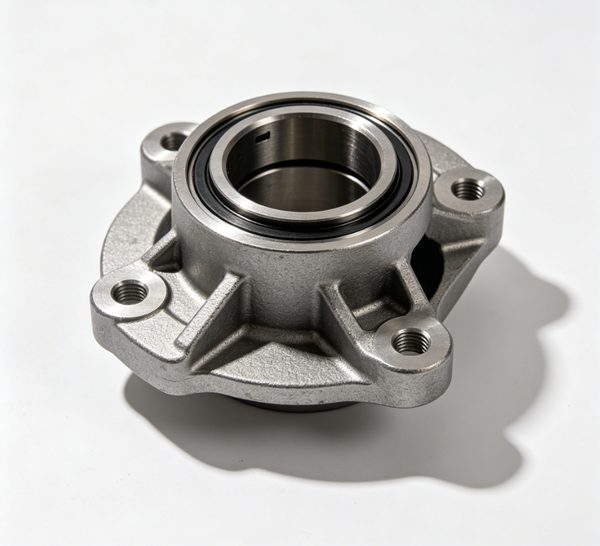


The brake band lever body is the pivoting arm that applies and releases the band brake of a windlass or mooring winch, holding the cable lifter or drum against the pull of an anchor chain or a mooring line. It is a load-bearing lever that sees static holding load for long periods plus shock when the brake is set or released under load, and it must remain operable after months of exposure on an open forecastle. Casting suits the lever because the pivot eyes, the clevis end, the band anchor pads and the operating link bosses form one continuous section with a favourable grain flow, and because the cast shape can be thickened locally at the pivot without adding a welded fabrication.
Specifications
| Parameter | Value |
|---|---|
| Material | GS-52 cast steel |
| Casting process | Investment casting |
| Dimensional tolerance | ISO 8062 CT6 to CT8 |
| Surface treatment | Two-pack epoxy / Hot-dip galvanising |
| Documentation | EN 10204 3.1 material certificate; PPAP / FAIR on request |
Material and process selection
GS-52 cast steel is the traditional grade for this part: a medium-carbon general-purpose cast steel with tensile strength in the 520 MPa class, good toughness and predictable weldability for repair if ever needed. Where the windlass operates in a permanently wet or aggressive atmosphere, or where the buyer prefers a stainless or corrosion-resistant grade, CF8M (316 equivalent) or AISI 316L castings are offered instead. We normally supply levers normalised or quenched and tempered to the hardness range agreed on the drawing, with the heat-treatment cycle recorded per batch. We confirm the design load, the required safety factor and any impact-test requirement before selecting the heat-treatment route.
Casting and CNC machining
The lever body is produced by silica sol investment casting, which holds the pivot-eye thickness and the clevis geometry without the draft and fillet limitations of sand casting, and keeps the surface clean enough that only functional surfaces need machining. Risers and chills are positioned to feed the pivot eye and the clevis bosses, the heat is verified by spectrographic analysis, and castings are then normalised or quenched and tempered. Machining covers pivot bore boring and reaming, clevis slot milling, band anchor pad facing, pin hole drilling and thread milling, all located from the two pivot datums so the lever geometry stays true through the stroke.
Tolerances and inspection
We hold tolerances to ISO 8062 CT6 to CT8, with the pivot bore machined to H7 or the drawing fit and the clevis slot held to the specified width tolerance. Key dimensions such as pivot-to-clevis centre distance, lever angle and pad flatness are recorded as variable data on the dimensional report rather than as pass or fail only. Inspection includes dimensional verification, visual examination of all surfaces, dye penetrant or magnetic particle testing of the pivot eye and clevis where specified, and hardness and tensile verification from the batch test bar. EN 10204 3.1 certificates, heat-treatment records, NDT reports and FAIR documentation accompany the shipment.
Corrosion and surface protection
GS-52 cast steel is a carbon steel and therefore requires a protective system: the usual specification is abrasive blast to the agreed grade followed by a zinc-rich primer and a two-pack epoxy top coat, or hot-dip galvanising where the geometry permits and the buyer accepts the drainage and venting provisions. Machined bores are masked during coating and greased before packing. Moreover, where the lever is supplied in CF8M or 316L, surfaces are passivated and pickled as standard. We do not apply a coating system that is not called out by the buyer without written agreement.
Packaging and logistics
We pack coated levers with edge protection and foam separators in seaworthy plywood cases, with the pivot bores capped and the machined surfaces protected by VCI film and desiccant. Generally, cases are banded to ISPM 15 heat-treated pallets or crated as a single unit for smaller batches. FOB Ningbo and CIF terms are both available, and we provide case-level weights and dimensions for onward transport planning.
CTA
- Drawing with the design brake load, safety factor and any impact test requirement.
- Specified grade: GS-52, CF8M, 316L or an alternative cast steel.
- Heat-treatment condition and required hardness range.
- Moreover, Pivot bore fit, clevis slot tolerance and any centre-distance control.
- Required NDT method (dye penetrant, magnetic particle or ultrasonic) and acceptance level.
- Coating system, colour and dry film thickness, plus masking requirements.
FAQ
Why specify a casting instead of a welded lever fabrication?
A casting gives a continuous section through the pivot eye and clevis with no weld in the highest-stress region, allows local thickening exactly where the bending moment peaks, and needs machining only on the functional surfaces. It also removes the inspection burden that comes with a fabricated weld.
What heat treatment do you apply to a GS-52 lever body?
The standard route is normalising, or quenching and tempering when higher strength or a specified hardness range is required. Overall, we record the actual cycle and the resulting mechanical properties from the batch test bar on the material certificate.
Can you supply the lever with the brake band, pins and bushings fitted?
We deliver the lever body fully machined, or manage the fitted assembly with bushings, pins and the brake band through approved partners, inspected and documented before shipment. Tell us the assembly level you need when you enquire.
How is the pivot bore kept concentric with the clevis?
Both features are machined from the same datums in one set-up sequence on a horizontal machining centre, and the resulting centre-to-centre distance and bore position are measured and reported on the dimensional inspection record.