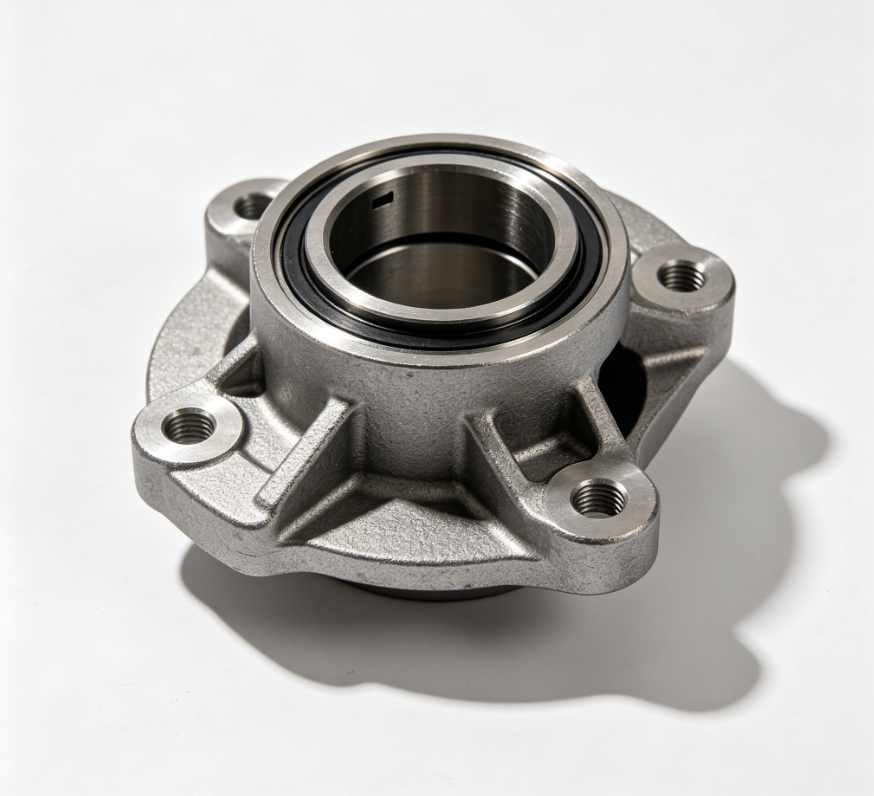
The chain stopper body is the deck-mounted housing that takes the anchor chain load off the windlass and transfers it into the hull structure during anchoring and mooring. Moreover, Ningbo Ruican supplies cast and machined stopper bodies to newbuild and repair yards worldwide. A cast body distributes shock loads smoothly through the pawl and seating faces, where a fabricated weldment tends to crack at the gussets, and our machined chain groove geometry keeps the chain seated correctly so the load stays on the stopper and off the windlass brake.
Specifications
| Item | Specification |
|---|---|
| Casting process | Silica sol lost wax investment casting; water glass process for heavy deck castings |
| Material options | Cast steel ASTM A216 WCB, duplex 2205 (ASTM A995 4A), nickel aluminium bronze C95800, manganese bronze C86300, CF8M stainless |
| Dimensional tolerance (ISO 8062-3 CT grade) | CT7 as-cast; CT5-CT6 on machined chain groove, pawl bore and seating faces |
| Machining | Horizontal boring and 4-axis VMC: pawl pin bore, chain groove profile, deck seating face, bolting pattern |
| Surface finish (Ra) | Ra 6.3-12.5 um as-cast; Ra 3.2 um machined; Ra 1.6 um on pawl bore and pin seats |
| Corrosion protection | Blast to Sa 2.5, zinc-rich epoxy primer plus marine topcoat, or bare bronze with passivation |
| Weight range | 45-650 kg per casting |
| Typical lead time | 6-8 weeks including tooling and first-article approval; 4-5 weeks for repeat orders |
Scope and options
Key features
- Moreover, Cast chain groove profile matched to stud link or studless chain diameter and pitch.
- Smooth radii through the pawl seating area, removing the stress raisers typical of welded assemblies.
- Full deck seating face machined flat so the load transfers into the foundation rather than the bolts.
- Optional bronze or stainless pawl pin seats for galvanic compatibility with the chain and hull.
- Thick section bosses cast with feeders sized from solidification simulation to prevent shrinkage.
- Permanent pattern tooling held by Ningbo Ruican for the service life of the vessel class.
Applications
- Anchor chain stoppers on bulk carriers and general cargo vessels.
- Mooring and anchoring systems on offshore support and construction vessels.
- Tugs, harbour tugs and escort tugs with high cycle anchoring duty.
- Repair and renewal orders during dry-docking and class renewal surveys.
- Deck outfit packages for newbuild hulls at Asian and European yards.
- Chain lockers and hawse pipe transition arrangements on dredgers.
Quality & compliance
Stopper bodies are supplied with EN 10204 3.1 certification traceable to heat and casting number, material test reports covering chemistry and mechanical properties, and a dimensional report mapped to the drawing. Ultrasonic testing to EN 12680 or ASTM A609 and magnetic particle or dye penetrant inspection on the load path are available on request, with radiography on the pawl bosses and seating face. Proof load testing can be arranged with a third party where the specification requires it, and Ningbo Ruican compiles the evidence pack for your surveyor. Type approval or class certification of the finished installed stopper remains the customer’s responsibility and that of their classification society; we supply the certified casting and the supporting documentation, not the class certificate.
FAQ
Can you cast the stopper body to our existing chain size and class rules?
Yes. We work strictly to your drawing and specification, including chain diameter, pawl geometry, seating face and bolt pattern. Where you tell us the applicable rule set, we review the drawing for castability and confirm material, section thicknesses and inspection scope in writing before tooling is cut, so there are no surprises at first-article stage.
Which material is best for a seawater-exposed deck stopper?
Nickel aluminium bronze C95800 is the usual choice for seawater-exposed stoppers because it resists dezincification, erosion and marine fouling and is galvanically well matched to the chain. Duplex 2205 suits owners wanting higher strength and pitting resistance at lower weight, while cast steel with a marine coating scheme remains the economical option for coated installations.
How do you verify the load path of the casting?
We verify the load path in three stages: solidification and stress simulation before tooling, non-destructive testing of the as-cast body along the pawl and seating areas, and dimensional verification after machining. Where the specification calls for it, proof load testing is arranged with an accredited third party and the result is added to the documentation pack.
What is the minimum order quantity for a renewal stopper?
Generally, there is no minimum order quantity. Ningbo Ruican regularly produces single replacement castings for dry-docking work, and the same tooling then supports repeat orders for sister vessels. Tooling cost for a one-off is quoted separately and transparently, so you can decide whether to cast new or repair the existing unit.
Do you supply the pawl, pin and bushes as well?
We can supply the cast and machined body on its own, or as a kit with machined pawl, pins, bushes and fasteners sourced or manufactured to your drawing. Most repair yards take the complete assembly to shorten the installation window during docking, while newbuild yards usually take the body only and fit their own standard hardware.
Can you work from a worn sample if no drawing exists?
Yes, provided you confirm that you hold the design rights. We 3D scan the removed unit, produce a drawing for your approval, and machine the chain groove to the nominal chain dimensions rather than the worn profile. Additionally, this route is common for older vessels where the original builder drawing is no longer available.
CTA
For a quotation on cast anchor chain stopper bodies, send your drawing, chain size and material requirement to Wendy She at sales@cnsandcasting.com, or reach her on WhatsApp at +86-13777124360, and Ningbo Ruican will respond within two working days.