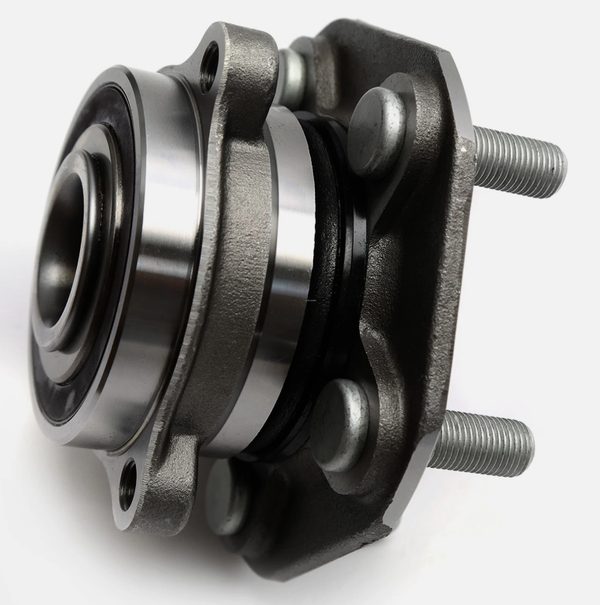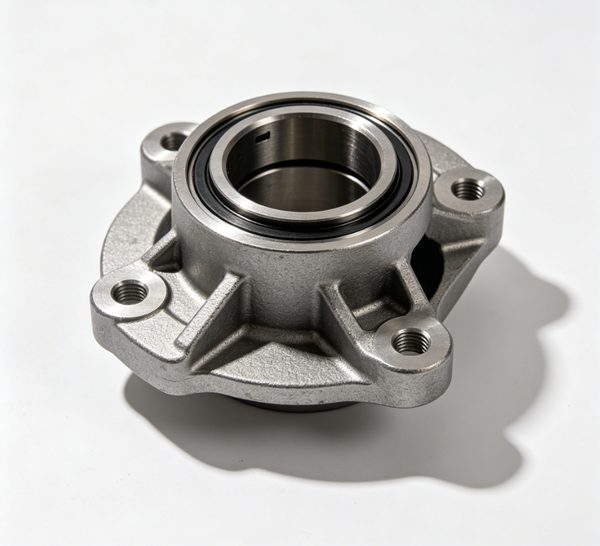


The suction turbine volute housing is the scroll-shaped air body that converts impeller rotation into the vacuum stream that lifts nuts, leaves and debris off the orchard floor. It mounts on the harvester chassis behind the intake head, running at impeller tip speeds that punish imbalance in the profile. Buyers report efficiency loss from rough internal surfaces, air leakage at the split flange, and impeller rub from drift in the bore-to-scroll relationship. We cast a smooth internal passage, then machine the shaft bore, clearance face and flange in one setup.
Specifications
| Casting process | Material options | Dimensional tolerance (ISO 8062-3 CT grade) | Machining | Surface finish (Ra) | Weight range | Typical lead time |
|---|---|---|---|---|---|---|
| Silica sol investment casting (lost wax) with ceramic core for enclosed scroll sections | HT200 / HT250 gray iron equivalent cast steel, 304 and 316 stainless steel, aluminium A356 on request | CT6–CT7 as cast; CT5 on shaft bore and flange datums | 4-axis CNC milling, precision boring, flange face turning, drilled and tapped mounting pattern | Ra 6.3 µm internal as cast, Ra 1.6 µm machined flange and bore, Ra 3.2 µm on the impeller clearance face | 12 kg – 48 kg | Tooling 28–35 days, samples 18–22 days, production 35–45 days |
Scope and options
Key features
- As-cast scroll profile with controlled wall thickness holds the designed expansion ratio and airflow efficiency.
- Moreover, Shaft bore and impeller clearance face machined in a single fixturing to guarantee concentricity under 0.05 mm TIR.
- Flat machined split flange with a controlled gasket surface eliminates vacuum loss at the joint.
- Stainless 316 or 316L option resists corrosion from damp leaf residue and orchard fertilizers.
- Generally, Internal passages deburred and smooth-flow finished to reduce turbulence and pressure drop.
- Additionally, Dynamic balance verification support for the assembled rotor and housing set on request.
Applications
- Self-propelled hazelnut harvesters
- Self-propelled and trailed olive harvesters
- Chestnut and walnut ground-collection suction machines
- Orchard debris and leaf suction trailers
- Municipal and vineyard vacuum collection units
Images
Quality & compliance
Each volute housing is delivered with EN 10204 3.1 material certification, a full dimensional report including bore concentricity and flange flatness, and pressure or vacuum leak test results where specified. Our IATF 16949 certified system governs melt control, shell building, pouring and heat treatment, with spectrometer analysis on every heat and mechanical testing on test bars from the same batch. PPAP Level 3 and First Article Inspection packages are available on request, and we can hold capability data on the shaft bore and clearance face across the first three production runs.
FAQ
How do you control impeller clearance on a cast volute?
We machine the shaft bore and the impeller clearance face in one setup on a 4-axis CNC cell, so the two features share a single datum. We then verify runout against the bore axis and record the result on the dimensional report. Moreover, tell us your minimum running clearance and we will set the machining tolerance band well inside it.
Can you produce the volute in stainless steel for corrosive orchard conditions?
Yes. 304 and 316 are routine for us. Where the machine handles wet leaf matter and fertilizer residue, 316 gives markedly better pitting resistance. We can also supply a cast steel volute with an internal coating if you prefer a lower material cost with surface protection.
What airflow volumes can the housing support?
Our current production volutes cover impeller diameters from 320 mm to 750 mm and airflow ratings roughly between 4,000 and 22,000 cubic metres per hour. If your design sits outside that range, send the impeller drawing and target duty point and we will confirm tooling feasibility.
Do you machine the inlet and outlet flanges to our bolt pattern?
Yes. All mounting flanges, inspection ports and drain bosses are machined and drilled to your drawing. We hold positional tolerance on bolt circles to your specified grade, and we can supply studs, helicoils or threaded inserts already fitted before shipment to save assembly time.
Can you help redesign a fabricated volute into a casting?
That is one of our most common projects. A fabricated scroll usually carries a long weld seam that distorts under heat and leaks over time. Converting to a single investment casting removes the seam, improves the internal surface finish and typically lowers unit cost from a few hundred pieces upward.
CTA
Share your volute housing drawings or impeller performance data and Ningbo Ruican will return a casting feasibility review, material options and a quotation within three working days. Contact Wendy She at sales@cnsandcasting.com or WhatsApp +86-13777124360 to start. Generally, more programs are listed on cnsandcasting.com.