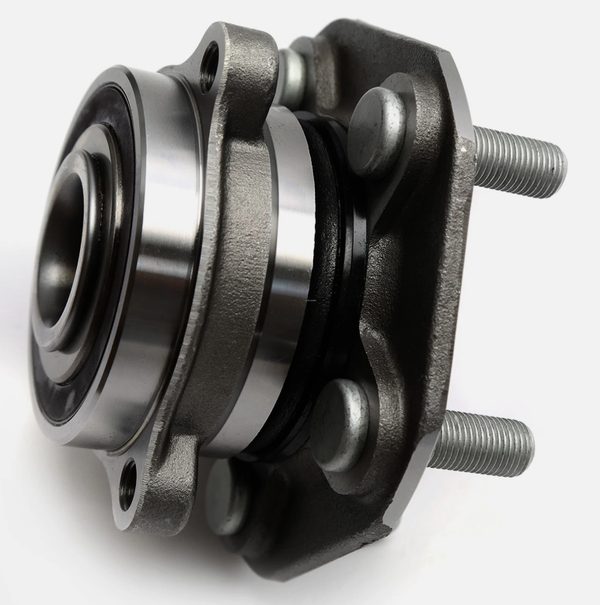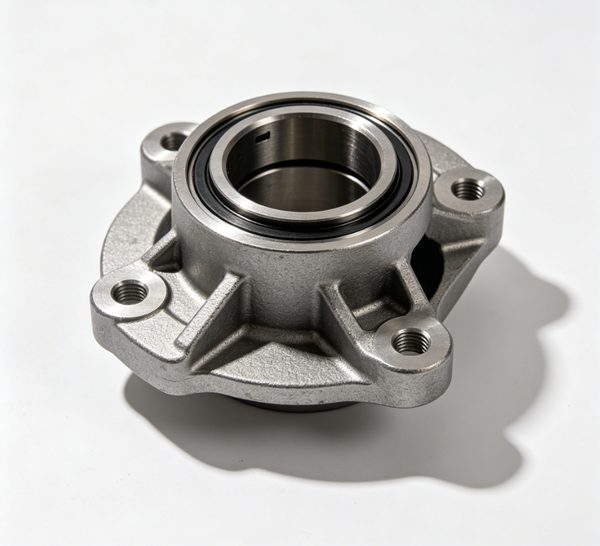


Additionally, Ningbo Ruican casts and machines the vibrating screen tension rail clamp casting as a build-to-print part. In general, tension rail clamps hold the side-tensioned screen media on a vibrating screen deck. Each clamp body traps the rail hook or the screen edge against the side plate and carries the tensioning load of the wire or polyurethane panel while the deck runs at 700 to 1000 rpm and 4 to 6 g. The part sees a fully reversing dynamic load at high cycle count plus the abrasion dust and fines that work into every joint on a screen.
Also, welded fabrications are common, and they fail predictably. In addition, the weld toe at the clamp ear starts a fatigue crack. Overall, the clamp face brinells where the rail bears on it. The bolt holes ovalise until the clamp loses preload and the screen panel starts flapping, which then tears at the hook. At the same time, a ductile iron casting holds a machined clamp face and a controlled fillet radius at the ear. It also holds so the stress concentration is designed rather than left to a weld toe. Applications include aggregate screening plants, coal preparation and wash plants, mineral processing scalping and sizing decks, fertiliser and potash screening, and recycling trommel and flat-deck screens.
Specifications
| Parameter | Value |
|---|---|
| Material | ductile iron |
| Dimensional tolerance | ISO 8062-3 CT6 |
| Surface treatment | Shot blasting |
| Documentation | EN 10204 3.1 material certificate; PPAP / FAIR on request |
Material and process
Moreover, EN-GJS-500-7 spheroidal graphite iron is the default. It gives around 500 MPa tensile strength with 7 percent elongation. Generally, this is the combination a vibrating clamp needs. Additionally, the part must stay stiff enough to keep the clamp face flat under preload. It must also be ductile enough to absorb the reversing deck load without a brittle crack. The graphite nodules also give useful damping, which lowers the amplitude of the resonant response at the clamp and reduces the noise radiated by the deck frame.
EN-GJS-450-10 is substituted when higher elongation and better toughness are wanted for very aggressive decks; EN-GJS-600-3 is used when a customer wants maximum stiffness and will accept lower elongation. For wet, acidic or saline screen environments the body is quoted in CF8M or AISI 316L instead. We cast all grades on the same tool, so grade changes do not force new tooling.
Casting and CNC machining
We produce the clamp body on the silica sol lost wax line for dimensional accuracy and a clean as-cast surface, with water glass available for larger clamp sizes. Gating and feeding come from the riser, so the thick clamp ear and the bolt boss solidify last. In general, this keeps porosity out of the ear fillet and the clamp face. Magnesium treatment for the ductile iron is verified per heat by wedge test, and nodularity, nodule count and graphite size are checked metallographically.
Also, in-house machining covers 3-axis and 4-axis milling of the clamp face and the rail seating groove. It also covers CNC turning of the barrel where a cylindrical seat is used. It also covers drilling and tapping of the clamp bolt holes, and deburring and edge break on the ear. In addition, the clamp face is machined after any stress relief, and tapped holes are gauged 100 percent.
Tolerances and inspection
Casting tolerance is ISO 8062-3 CT6 as cast with CT5 on the machined clamp face, rail groove, bolt holes and datum faces. Clamp face flatness is held to 0.08 mm, groove width is held to plus or minus 0.10 mm, and tapped holes are checked with go and no-go gauges. We hold bolt hole centre distance to plus or minus 0.15 mm across the body so the clamp does not fight the side plate on assembly. Inspection includes a CMM dimensional report on a defined sample from the production lot. It also includes a tensile test on a cast-on test bar from the same heat. It also includes a Brinell hardness check, and a metallographic nodularity report on request.
Documentation includes EN 10204 3.1 material certification tied to the melt heat number. It also includes the mechanical test record for the heat, and the dimensional inspection report. Additionally, we perform magnetic particle or dye penetrant examination where the buyer specifies it, to the buyer’s acceptance standard. At the same time, PPAP and FAIR packages are available. Ningbo Ruican operates under IATF 16949 and works to ISO 9001 documented process control.
Wear and heat-treatment options
Ductile iron clamp bodies are supplied as cast and stress relieved; no quench is applied because the part needs toughness rather than hardness. Where the clamp face wears in slurry or high-fines duty, optional hardened steel wear inserts, a machined-in replaceable face plate, or a Ni-hard clamp face variant are offered. An austempered ductile iron (ADI) variant at 900 to 1000 MPa tensile strength can be quoted where the customer wants higher strength at the same geometry, with the trade-off that ADI needs a controlled austempering cycle and the customer’s acceptance criteria must be agreed before tooling is released. Moreover, surface options include shot blasting for a uniform finish, zinc-free rust preventive for storage. A protective primer when the clamp is supplied as part of a painted deck assembly.
Packaging and logistics
Generally, we pack clamp bodies in plywood cases with individual separators. Additionally, this protects the machined clamp face and the tapped holes in transit. In general, smaller clamps go in cartons inside a plywood case. Still, we protect parts with VCI film and desiccant for sea freight, and machined faces carry a rust-preventive coating. Case markings, part numbers, heat numbers and lot quantities are printed on the packing list; shipment is FOB Ningbo or CIF to the buyer port. Assemblies supplied with bolts and rails can be kitted and packed per deck section if the customer’s installation schedule requires it.
CTA
- Drawing or 3D model showing the clamp face, rail groove and bolt pattern, with the current revision.
- Screen media type and panel thickness, so the groove and clamp face can be checked before tooling.
- Material grade callout: EN-GJS-500-7 default, with EN-GJS-450-10 or EN-GJS-600-3 as alternatives.
- Deck side plate thickness and bolt spacing, so clamp length and hole centres are confirmed.
- Quantity per order and annual volume, including any pilot release.
- Documentation package and any required NDT standard, acceptance level and sample size.
- Coating or finish requirement, and the destination port for freight planning.
FAQ
Why cast the clamp instead of welding it from plate?
A weld toe at the clamp ear is a built-in stress raiser in a part that sees 700 plus reversing cycles per minute. A casting puts a controlled fillet and a smooth load path at that point, removes the weld inspection and post-weld straightening steps, and holds the clamp face and bolt pattern in one tool so every piece fits the deck without hand fitting.
Can you hold the bolt hole spacing on a casting?
Yes. The hole pattern is machined, not cast, so centres are held to plus or minus 0.15 mm on a jig-mounted setup. If your side plate is already drilled, send the plate drawing and we will confirm the clamp pattern against it before cutting the tool.
Do you supply the bolts and rails as well?
In addition, we cast and machine the clamp body. Overall, bolts, spring washers and tension rails are normally customer-supplied standard items. We can kit and pack them with the clamps if you provide the specification and part numbers.
How do you control porosity in the ear?
The ear and bolt boss are the last sections to solidify. Overall, they are fed directly from the riser and the gating is sized for directional solidification toward the ear. Each heat is checked by wedge test for nodularity and shot quality, and castings are visually and dimensionally checked before machining.