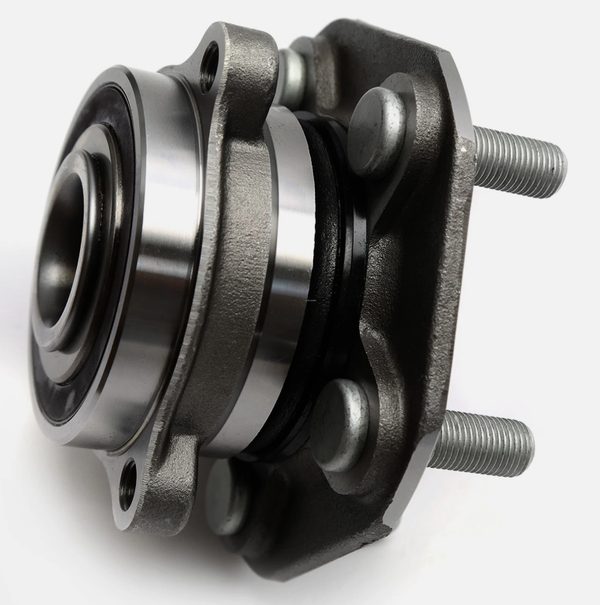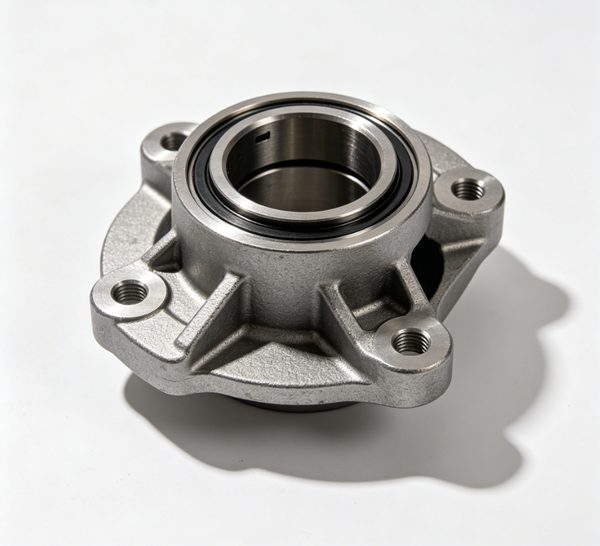


The hinge arm body carries a ship’s watertight or weathertight door leaf and transfers its weight and the closing wedge load into the bulkhead or coaming. It must hold the door leaf in precise alignment so that the gasket compresses evenly, which makes the hinge geometry a sealing requirement rather than simply a structural one. Moreover, the arm is exposed to wash-down, condensation and, on weather deck doors, direct salt spray. Casting the arm in one piece reproduces the two eye bosses, the offset arm and the door-leaf mounting pad with the correct angular relationship, and gives a smooth, pore-free stainless surface that is easy to keep clean and to coat.
Specifications
| Parameter | Value |
|---|---|
| Casting process | Investment casting |
| Dimensional tolerance | ISO 8062 CT5 to CT7 |
| Surface treatment | Passivation |
| Documentation | EN 10204 3.1 material certificate; PPAP / FAIR on request |
Material and process selection
AISI 316L is the normal choice: its molybdenum addition resists chloride pitting in wet, poorly ventilated spaces, and its low carbon content keeps the heat-affected zone safe if the arm is ever welded to a coaming on site. Duplex 2205 is available where higher strength or better chloride stress-corrosion performance is specified, and CF8M castings are offered where a buyer wishes to match an existing cast 316 grade. Because hinge arms are often supplied in sets, we keep pattern-to-pattern dimensional consistency so that replacement arms match the door hardware already in service without re-fitting.
Casting and CNC machining
The hinge arm is produced by silica sol investment casting, which holds the arm offset and the boss centres without the parting-line offsets that would disturb door alignment. Castings are solution annealed, quenched, cut and ground, then 100% pickled and passivated. Machining includes eye bore boring and reaming, thrust face facing, door pad milling, bolt hole drilling and countersinking, and any coaming weld preparation. We machine eye bores from the leaf pad datum so that the swing axis and the gasket plane stay square to each other within the drawing tolerance.
Tolerances and inspection
Generally, tolerances follow ISO 8062 CT5 to CT7. The hinge eye bores are machined to the drawing fit, typically H7, with the bore axis square to the door pad within the stated perpendicularity, and pad faces are held flat so the gasket load is even. Inspection covers full dimensional verification. It also covers dye penetrant testing of the arm-to-boss transition and all machined surfaces. It also covers surface roughness checks on pad faces, and passivation verification. Documentation includes EN 10204 3.1 material certificates, dimensional reports, NDT records, passivation confirmation and PPAP / FAIR packages where the door set is supplied as a controlled item.
Corrosion and surface protection
All castings are pickled and passivated to restore a clean, uniform passive layer and to remove free iron contamination from grinding and machining. Where the door interface is painted as part of the yard’s system, we can supply the arm with a primer already applied to the specified dry film thickness, masking the bores and pads. Bronze or stainless bushings, thrust washers and the hinge pin can be supplied loose or fitted, and we confirm the intended coupling between pin and arm so that the correct clearance is built in from the start.
Packaging and logistics
Hinge arms are delivered as matched sets where required, with the bores capped and the pads protected by VCI film. We pack parts in seaworthy plywood cases or cartons with foam blocking and desiccant, banded to ISPM 15 heat-treated pallets. Additionally, small sets ship as consolidated cartons on a single pallet to reduce freight cost. In general, we ship FOB Ningbo or CIF, with case-level weights and dimensions provided for yard logistics.
CTA
- Drawing showing the hinge centres, eye bore sizes and door pad geometry.
- Material grade: AISI 316L, CF8M or duplex 2205.
- Door leaf weight and any class or yard standard applicable to the door set.
- Required bore fit, thrust face finish and pad flatness.
- Whether bushings, washers and hinge pins are to be supplied loose or fitted.
- Passivation requirement and any primer or coating specification.
FAQ
How do you keep hinge geometry consistent across a set of arms?
We machine all arms in a set come from the same pattern family and with the same fixtures and datums, so the eye bore spacing, arm offset and pad geometry repeat from piece to piece. In general, we hold the first article as a reference for the batch.
Can the arm be welded to the door or coaming on site?
Also, AISI 316L is readily weldable and the low-carbon composition limits sensitisation. We can supply the required weld preparation as part of the machined part, but the welding procedure and any post-weld passivation remain the responsibility of the yard.
Do you supply the hinge pin and bushings as well?
Yes. Pins, bushings and thrust washers can be supplied loose or assembled and match-marked to the arm. In addition, tell us the material pairing and clearance you want and we will build it into the machining.
What documentation is issued with a door hinge arm order?
EN 10204 3.1 material certificates, dimensional inspection reports, NDT reports where specified, passivation records and FAIR or PPAP documentation if the door is being delivered as a controlled item.