


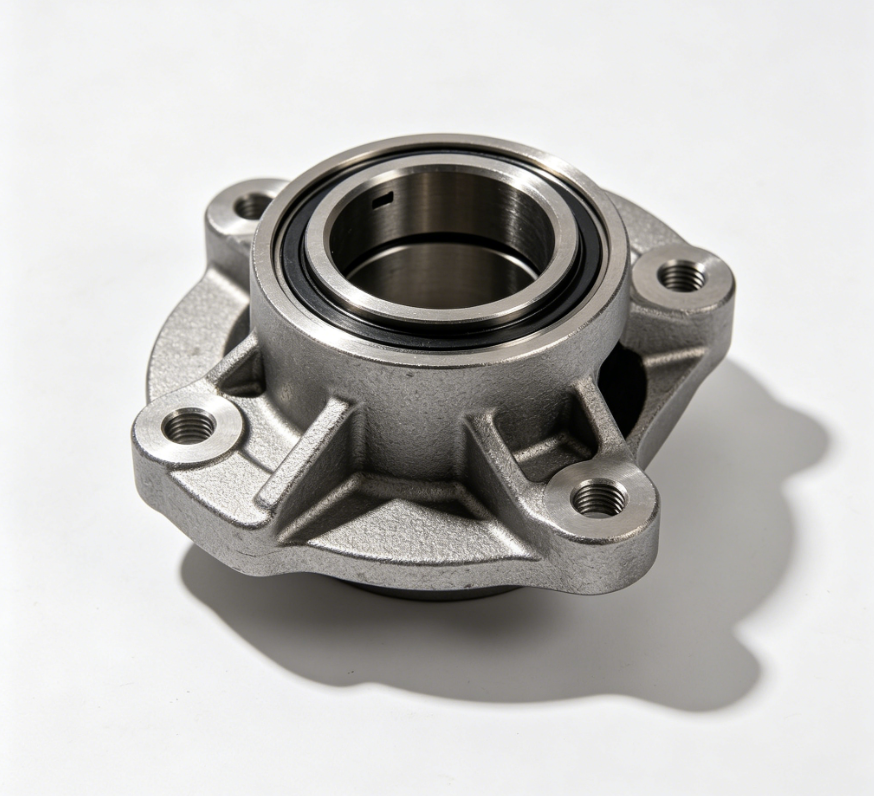
The engine mounting bracket is the structural link between the powertrain and the vehicle body or subframe. It must hold static engine weight, transmit torque reaction under load, and keep NVH behavior predictable — all while surviving 15+ years of vibration, temperature cycling and occasional shock loads. Because the bracket is load-bearing but not a wear part, the failure mode that matters is fatigue cracking at section transitions, which makes casting quality and fillet geometry decisive.
Ningbo Ruican manufactures engine mounting brackets in QT500-7 ductile iron (ISO 1083, ASTM A536 80-55-06 equivalent) by silica sol investment casting. The near-net-shape process lets us reproduce the bracket’s swept geometry, integrated bosses and generous fillets without the machining waste of machining-from-solid or the draft constraints of sand casting. The result is a bracket with continuous nodular structure and verified mechanical properties, ready for the vehicle assembly line.
Brackets are CNC machined at the stud pads, bore and bolt faces, and can be supplied with threaded inserts, studs or elastomer isolator sub-assembly per customer BOM. For programs feeding automotive OEM lines we provide full PPAP Level 3 documentation, Cpk capability studies on critical hole patterns, and 100% critical-dimension gauging.
Key Specifications
| Parameter | Specification |
|---|---|
| Material | QT500-7 ductile iron (ASTM A536 80-55-06 equivalent) |
| Manufacturing Process | Silica sol investment casting + CNC machining |
| Mechanical Properties | Tensile ≥ 500 MPa, yield ≥ 320 MPa, elongation ≥ 7% |
| Critical Tolerances | Stud hole patterns ±0.05 mm; bore IT7 |
| Weight Range | 0.3–4 kg |
| Finish | Machined faces Ra 1.6–3.2 µm; e-coat / powder coat per spec |
| Inspection | Nodularity & hardness per heat, CMM layout, 100% gauge checks |
| Documentation | PPAP Level 3, EN 10204 3.1, SPC capability (Cpk ≥ 1.33) |
| Applications | Passenger car & LCV engine mounts, transmission mounts, subframe brackets |
Casting vs Machining-from-Solid: The NVH-Relevant Difference
A bracket hogged from solid bar inherits straight grain and sharp corners that act as stress risers — cracks start there. A cast bracket is shaped to follow the load path with smooth fillets at every transition, which is precisely what fatigue engineers want. In production, investment casting also removes 50–70% of the machining content versus bar-stock, at volumes from 500 to 100,000 pieces per year, making it the rational process for engine mount families.
Why Choose Ningbo Ruican
- IATF16949 Certification
- Integrated casting + CNC + heat treatment — one accountable partner for geometry, hardness and fit
- Prototype to serial: first articles in 2–3 weeks, then same tooling scales to mass production
- Ductile iron program: QT400-18 to QT700-2 plus carbon steel variants for high-load brackets
- Export experience to European and North American tier-1 and OEM programs


Отзывы
Отзывов пока нет.