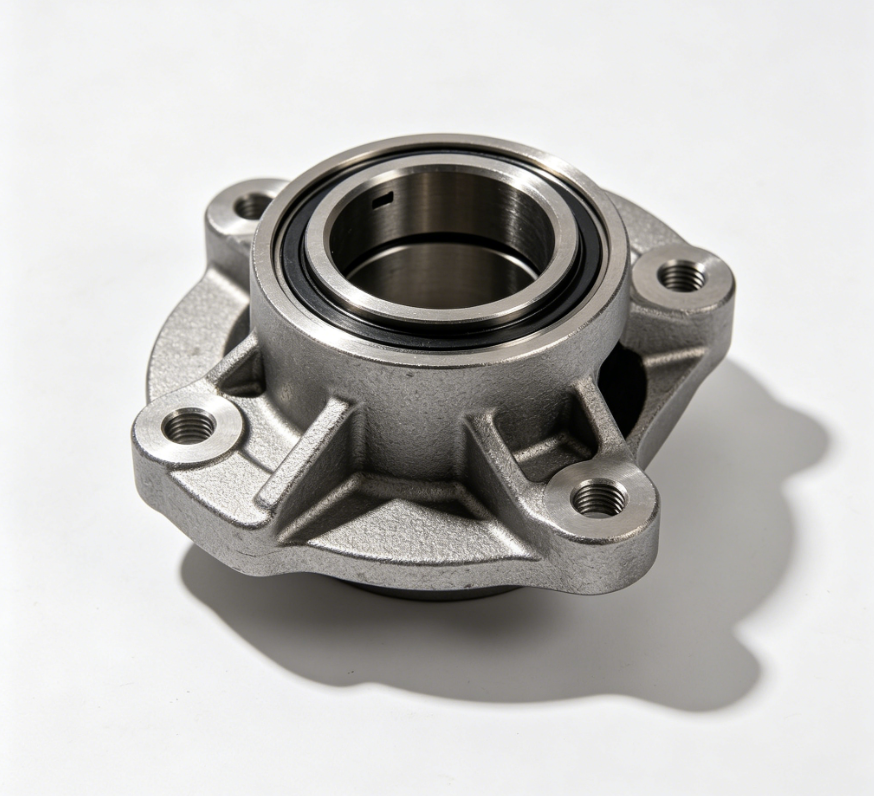
The globe valve body is a pressure-retaining component whose internal seat area and flow passages define the valve’s throttling performance. Unlike a simple two-piece gate body, the globe body carries complex internal geometry—seat ring bosses, the horizontal flow partition, and threaded or welded bonnet connections — which is precisely the kind of shape investment casting reproduces far better than machining from solid.
Ningbo Ruican manufactures globe valve bodies in ASTM A216 WCB carbon steel (with WC6, WC9, CF8, CF8M, and CF3M options) by investment casting, then machines the bodies complete: end connections (threaded, socket weld, or flanged per ASME B16.11/B16.5), seat bores, bonnet joint, and gland area. The silica sol process delivers dense, leak-tight bodies with minimal internal porosity in the thick seat bosses—the region where sand-cast bodies most often fail pressure testing.
Everybody can be supplied normalized and tempered, with hydrostatic shell and seat testing performed, and NDE (RT/MT per ASME B16.34 supplementary requirements) on request. Documentation includes EN 10204 3.1 material certificates with full heat traceability, making the bodies suitable for steam, oil & gas, and process piping systems from class 150 to class 800.
Key Specifications
| Parameter | Specification |
|---|---|
| Material | ASTM A216 WCB (WC6 / WC9 / CF8 / CF8M / CF3M options) |
| Design Standard | ASME B16.34, API 598 |
| Manufacturing Process | Silica sol investment casting + CNC machining |
| Size Range | 1/2″ – 3″ class 150–800 (larger by quotation) |
| End Connections | Threaded / socket weld / flanged per ASME B16.11 / B16.5 |
| Heat Treatment | Normalized + tempered per A216 |
| Testing | Hydrostatic shell & seat test; RT/MT NDE on request |
| Documentation | EN 10204 3.1 certificates, chemical/mechanical reports, traceability |
| Applications | Steam, oil & gas, chemical, water and HVAC systems |
Why Investment Casting for Globe Bodies
The globe body’s internal partition and seat bosses are thick, heavily loaded sections that must be sound. Investment casting with silica sol shells keeps the steel clean and feeds the heavy sections properly, so bodies pass hydrostatic testing at first attempt instead of after rework. Combined with near-net-shape economy — 1.5–3 mm stock instead of 8–12 mm on sand castings—OEMs see lower total cost per body and a supply partner who understands pressure-retaining part discipline.
Why Choose Ningbo Ruican
- 17+ years casting pressure-retaining components for the valve industry
- Full alloy program: WCB, WC6, WC9, CF8, CF8M, CF3M, and special grades on request
- Machined-complete supply with pressure testing and NDE documentation
- Valve-sector quality culture: RT procedures and acceptance per ASME B16.34
- IATF 16949-certified quality system applied to every valve program