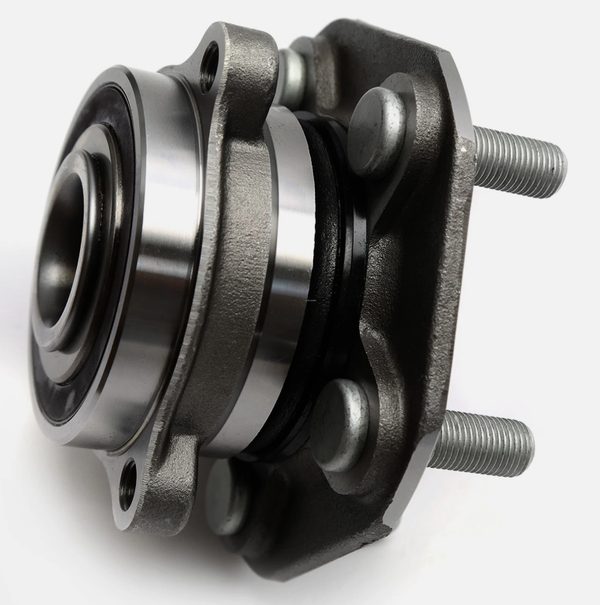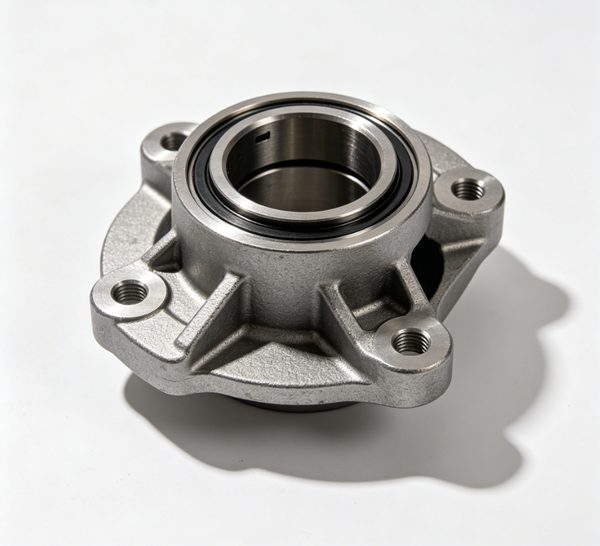


The davit head sheave bracket body is the structural casting at the head of a lifeboat or rescue boat davit that carries the sheave, sheave pin and fall guides through which the wire rope runs during launch and recovery. It sits at the top of a load path that must operate after long periods of idleness in salt-laden, spray-washed air. It must still function during an emergency launch with a fully loaded boat. Because the bracket combines a rope-load path with a bearing interface, it is a good candidate for casting: the yoke, gussets, bosses and pin bores are formed in one piece with no welded joints in the loaded section, and only the sheave bore, pin bore and mounting faces need machining.
Specifications
| Parameter | Value |
|---|---|
| Material | aluminium |
| Casting process | Investment casting |
| Dimensional tolerance | ISO 8062 CT5 to CT7 |
| Surface treatment | Passivation |
| Documentation | EN 10204 3.1 material certificate; PPAP / FAIR on request |
Material and process selection
We normally cast the bracket body in AISI 316L (UNS S31603) for general deck service, where its molybdenum content gives useful resistance to chloride pitting and crevice attack, or in duplex 2205 (UNS S32205) where higher yield strength and better chloride stress-corrosion resistance justify the extra cost. The sheave pin bush, wear ring or insert is supplied in nickel-aluminium bronze (CuAl10Fe5Ni5 / C95800 class), which combines seawater corrosion resistance with good bearing behaviour against a stainless pin. The 316L bracket and Ni-Al bronze bush are a widely used pairing; we confirm the galvanic couple, anode-to-cathode area ratio and any insulation or coating requirement with the buyer before releasing the pattern.
Casting and CNC machining
Still, patterns are produced as wax assemblies with gating designed to feed the boss sections and keep the yoke free of shrinkage. We build shells in a silica sol (water-glass-free) binder system, dewaxed and fired, then poured under controlled chemistry verified by spectrographic analysis of each heat. After knock-out, cutting and grinding, the castings are solution annealed, quenched and pickled. Also, machining covers face and datum milling, pin bore boring, sheave cavity turning, bolt circle drilling and thread milling on 3- and 4-axis vertical machining centres, with bores finish-bored in the same set-up as their datums to protect coaxiality.
Tolerances and inspection
Generally, dimensional tolerances follow ISO 8062 CT5 to CT7, with tighter classes on machined fits and CT7 on as-cast outlines. Overall, the sheave pin bore is typically held to H7 with 0.05 mm TIR coaxiality against the mounting face, and machined surfaces are finished to Ra 1.6 um. Inspection includes 100% visual and dimensional verification against the drawing, dye penetrant testing of machined surfaces and casting transitions to the acceptance level the buyer specifies, and hardness verification on a sample basis. EN 10204 3.1 material certificates, dimensional inspection reports, NDT reports, heat-treatment records and PPAP / FAIR documentation are issued with each shipment.
Corrosion and surface protection
Cast and machined 316L surfaces are passivated to remove free iron and restore the passive film, then optionally glass-bead blasted for a uniform finish. Additionally, where the bracket is exposed to continuous wetting, glass-flake epoxy or a two-pack marine paint system can be applied to the buyer’s specification. Nickel-aluminium bronze components are supplied as-cast or machined without passivation. We note that the bronze should not be painted in way of bearing surfaces. Stainless fasteners, insulating washers and anti-seize compounds are available as part of the delivered kit when specified.
Packaging and logistics
Still, we pack parts in seaworthy plywood cases with VCI film, desiccant and foam blocking, and are banded to ISPM 15 heat-treated pallets for export. Machined bores receive protective sleeves or end caps. We ship FOB Ningbo or CIF to the port of your choice, and provide packing lists, weights and dimensions per case so that the davit maker can plan site assembly.
CTA
- 2D drawing with tolerances plus a 3D model or sample part where available.
- Material grade for the bracket body and for the sheave bush or insert.
- Sheave pin diameter, bearing type and required bore tolerance.
- Required NDT method, coverage and acceptance level.
- Surface protection and finish requirement (as-cast, blasted, passivated, painted).
- Annual quantity, batch sizes, delivery port and required documentation package.
FAQ
Can you cast the bracket so the as-cast surface only needs minimal machining?
Yes. Silica sol investment casting reproduces the yoke, gussets and boss details close to net shape, so typically only the pin bore, sheave cavity, mounting faces and bolt holes require machining. Overall, that keeps the load path continuous and removes welded joints.
Which material should I choose for a bracket on an exposed davit?
At the same time, AISI 316L covers most deck service. For brackets that stay wet, are exposed to crevice conditions or carry higher loads, duplex 2205 gives higher strength and better chloride stress-corrosion resistance. Moreover, we use nickel-aluminium bronze for the bearing insert, not for the bracket body in most designs.
How do you avoid galvanic corrosion between the bronze bush and the stainless bracket?
Additionally, we agree the material pairing with the buyer up front, keep the bronze surface area small relative to the stainless body, and can supply insulating washers, sleeves or a coating on the mating face. We apply sealing compound at assembly where specified.
Can you supply replacement brackets from a sample instead of a drawing?
Yes. We measure the sample, rebuild the pattern and produce a first-article report for approval before running the batch. Legacy davit heads with obsolete bore or pin dimensions are a routine job for us.