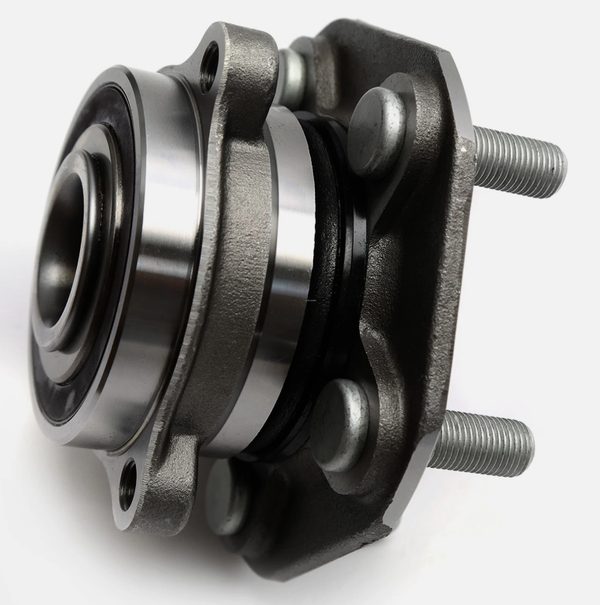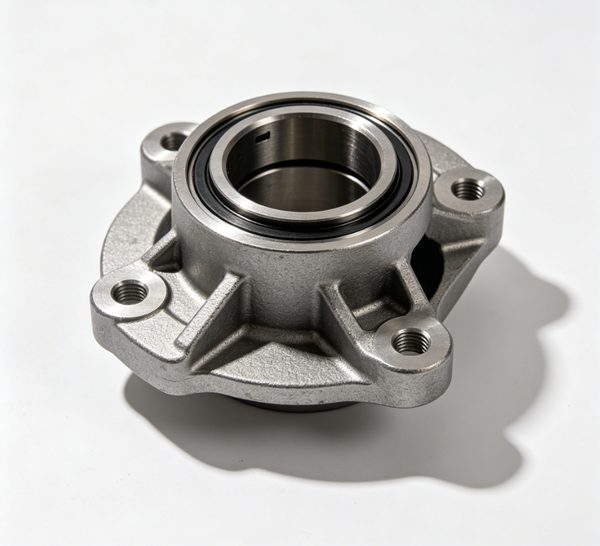


The blow bar holder block is the load-transfer interface between the rotor of an impact crusher and the blow bars that do the breaking. It carries the full impact reaction, the centrifugal load of the blow bar and the clamping preload of the wedge or bolted locking set, so it works under repeated shock rather than steady load. We cast and CNC machine the holder block rather than fabricate it because the section varies sharply from the rotor dovetail root to the blow bar seating face, and any internal discontinuity becomes a crack initiation site under shock loading. Casting puts metal where the stress path runs; machining then brings the dovetail, seating face and wedge pocket to size.
Specifications
| Item | Specification |
|---|---|
| Part name | Impact crusher blow bar holder block |
| Typical size range | 120–900 mm length, 15–180 kg finished weight |
| Casting process | Resin-bonded sand casting for heavy sections; investment casting for compact holders and wedge blocks |
| Materials | High-manganese Hadfield steel (Mn13 / Mn18Cr2), high-chrome white iron (Cr15Mo / Cr26), ductile iron QT450-10 / 500-7, alloy steel 42CrMo4 |
| Heat treatment | Water quench solution treatment for Hadfield steel; quench and temper for 42CrMo4; stress relieving for ductile iron holders |
| Casting tolerance | ISO 8062 CT6–CT8 depending on wall thickness and overall size |
| Machining | CNC machining centre and CNC boring mill: rotor dovetail, blow bar seat, wedge pocket, locking bolt holes |
| Machining tolerance | Drawing controlled; +/-0.05 mm typical on seating and dovetail faces |
| Surface finish | Ra 1.6–3.2 µm on machined seats; Ra 6.3–12.5 µm as-cast where specified |
| Hardness | Hadfield steel 187–229 HB in the as-quenched austenitic condition; high-chrome variants 45–58 HRC; 42CrMo4 28–34 HRC after quench and temper |
| NDT | Magnetic particle or dye penetrant inspection on machined faces, ultrasonic testing to EN 12680 severity level 2 or 3 on critical load zones |
| Balancing | Rotor set matched-weight holders machined to a stated weight window on request |
| Documentation | EN 10204 3.1 certificate, hardness map, heat treatment chart, dimensional report, FAI report and PPAP level 3 |
| Production volume | Prototype, sample and series, minimum quantity by agreement |
Key features
- Dovetail and wedge pocket machined for repeat blow bar change-out with consistent clamp preload and no drift of the impact angle.
- High-manganese Hadfield steel work hardens under impact, so the seating face gains surface hardness in service while the core stays tough.
- Riser and feed design plus solidification simulation keep shrinkage away from the highly loaded dovetail root.
- Optional high-chrome white iron insert faces where abrasive wear dominates over impact loading.
- Interchangeable with OEM holder geometry; reverse engineered from a sample part drawing when no drawing exists.
- Set-matched machining keeps rotor balance within the specified unbalance limit after blow bar replacement.
Applications
- Horizontal shaft impact crushers for aggregate and recycled concrete.
- Vertical shaft impact crushers running rock-on-rock or rock-on-anvil configurations.
- Secondary and tertiary crushing stages in quarry and mining circuits.
- Mobile impact crushing plants and tracked recycling units.
- Cement and lime pre-crushing Feed preparation lines.
Quality and compliance
Ningbo Ruican operates an IATF 16949 certified quality system, and every holder block is released against that process discipline rather than by visual sorting only. First article inspection covers full dimensional layout plus material verification, and we submit PPAP level 3 documentation for series programmes. Each heat is accompanied by an EN 10204 3.1 inspection certificate with chemical analysis and mechanical properties, supported by hardness test reports taken on the actual casting and by NDT reports covering magnetic particle, penetrant or ultrasonic examination of the critical zones. Heat treatment batches carry their own furnace chart records, so traceability runs from melt number through to the finished machined part.
FAQ
What information do you need to quote a blow bar holder block?
Send the drawing with material specification, hardness requirement, heat treatment condition, NDT level and annual volume. If you only have a worn sample, we can measure it, produce a 3D scan and return a manufacturing drawing for your approval.
Which material should I choose for high impact versus high abrasion?
Hadfield manganese steel is the default when the rock is large, hard and delivered with high impact energy, because it work hardens and resists cracking. High-chrome white iron suits finer, highly abrasive feed where impact loads are lower.
Do you supply the matching wedge, locking block and bolts?
Yes. We can machine and supply the complete holder assembly as a kit, so the clamping set arrives matched and ready to fit without additional fitting work at the plant.
Can you machine the holders to a weight window for rotor balancing?
We routinely machine rotor sets to a stated weight spread and record the finished mass of each part on the inspection report so your balancing department can allocate positions without re-weighing.
What is the typical lead time for a first article sample?
Tooling and sample production generally take four to six weeks depending on section size and heat treatment route. Series deliveries follow once the first article has been approved.
CTA
Need a quote for Impact crusher blow bar holder block? Send your drawing to sales@cnsandcasting.com or WhatsApp +86 137 7712 4360 for a fast RFQ response from Ningbo Ruican.