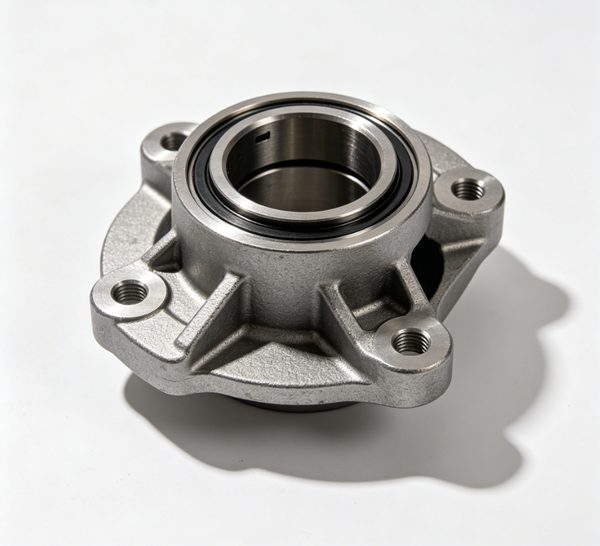


Ningbo Ruican produces investment cast orthopedic reduction forceps bodies for surgical instrument OEMs requiring repeatable geometry, clean surfaces, and documented material traceability. Using the silica sol lost wax process, we cast the near-net-shape forceps body complete with serrated locking jaw profiles and ratchet features, then finish-machine the pivot bores to drawing tolerance. Every production batch is supplied to the customer’s drawing and Quality Agreement, giving instrument manufacturers a stable, cost-effective alternative to bar-stock machining.
Key Features
- Serrated locking jaws cast to near-net shape — sharp, uniform tooth geometry reproduced shot to shot, minimizing hand finishing and preserving grip performance on bone fragments.
- Integral ratchet mechanism features — ratchet arm seat, tooth rack form and stop shoulders cast in, reducing weld-up and secondary assembly operations.
- CNC-machined pivot bores — precision drilled and reamed bores maintain concentricity across the two body halves for smooth, backlash-controlled joint action.
- Surface finish ready for passivation and electropolishing — as-cast Ra typically 3.2-6.3 µm, supporting downstream cleanability requirements for reusable instruments.
- Full heat treatment with certified hardness — H1025 ageing of 17-4PH delivers 32-38 HRC with consistent strength across thin and thick sections.
- Material traceability per heat lot — each melt is identifiable from ingot to finished part, with EN 10204 3.1 documentation available.
Materials & Heat Treatment
| Material | Standard | Condition | Application note |
|---|---|---|---|
| 17-4PH stainless steel | ASTM A564 / AMS 5643 | Solution annealed + aged H1025 (31-38 HRC) | Default choice for reusable forceps bodies requiring high strength plus corrosion resistance |
| 17-4PH stainless steel | ASTM A564 / AMS 5643 | H900 / H1075 on request | Higher or lower strength variants per instrument design load |
| AISI 316L stainless steel | ASTM A743 CF-3M / EN 1.4404 | Solution annealed | Austenitic option where maximum corrosion resistance and non-magnetic behaviour are specified |
| AISI 316L stainless steel | ASTM A743 CF-3M | Stress relieved | For bodies subject to repeated autoclave cycling |
| 17-4PH / 316L | ASTM / EN equivalents | Age / anneal per drawing | Certification to customer-specified national standard on request |
Specifications
| Parameter | Value |
|---|---|
| Casting process | Silica sol investment casting (lost wax); water glass process offered for cost-sensitive, lower-tolerance parts |
| Casting weight range | 0.05 kg – 8.0 kg per piece (typical forceps body 0.08 – 0.45 kg) |
| Dimensional tolerance | ISO 8062 CT4-CT6 (silica sol process); CT7-CT8 available via water glass route |
| Minimum wall thickness | 1.2 mm achievable on small cross sections |
| As-cast surface roughness | Ra 3.2 – 6.3 µm |
| Machining capability | 3/4/5-axis CNC machining centres, CNC turning, drilling, reaming, tapping; typical machined tolerance ±0.01 mm on pivot bores and critical datums |
| Secondary operations | Passivation, electropolishing, bead blasting, vibro-finishing, laser marking, assembly fit-up |
| MOQ | 200 pieces per part number for new tooling; lower quantities negotiable for prototype and validation lots |
| Tooling lead time | 15-25 days for wax die and first article samples |
| Production lead time | 30-45 days after sample approval, depending on order volume |
Applications
- Tibial plateau and tibial shaft fracture reduction forceps for trauma sets
- Large fragment and small fragment reduction clamps used in open reduction internal fixation (ORIF) procedures
- Pelvic and peri-articular bone reduction instruments
- Reusable surgical instrument trays supplied to orthopedic device OEMs and hospital group suppliers
- Veterinary orthopedic instrument manufacture using the same platform geometry
Quality & Documentation
Ningbo Ruican operates an IATF 16949 certified quality management system, applying automotive-grade process control, statistical capability studies, and full heat-lot traceability to every casting programme, including medical and surgical instrument components.
Process selection — silica sol vs. water glass. For orthopedic reduction forceps bodies, the silica sol process is the default recommendation: it delivers ISO 8062 CT4-CT6 tolerances, reproduces fine serration detail, and produces surfaces suitable for passivation with minimal stock removal. The water glass route remains available for larger, less complex parts where tight tolerance is not critical and unit cost is the primary driver. Our engineers recommend the correct route during quotation, based on drawing tolerances, surface specification, and annual volume.
Documentation supplied:
– EN 10204 3.1 material certificates, including chemical analysis, mechanical properties and heat treatment records
– First Article Inspection (FAI) dimensional reports against ballooned drawings
– PPAP-style documentation packages (process flow, control plan, PFMEA, MSA, capability studies) supplied under the customer’s Quality Agreement
– Heat-treatment charts, hardness maps, and destructive test reports per batch on request
– Surface finish verification records and passivation certificates
Important note. Ningbo Ruican is not an ISO 13485 contract manufacturer. Medical and surgical parts are supplied as components only, and all quality, validation, and documentation packages are delivered strictly under the customer’s Quality Agreement, with responsibility for regulatory approval resting with the customer as legal manufacturer.
Why Ningbo Ruican
- 17 years of investment casting experience in silica sol and water glass lost wax processes, serving export markets worldwide.
- One-stop casting plus CNC machining under one roof, eliminating the interface risk and lead time of splitting casting and machining across vendors.
- OEM and ODM programmes from drawings or samples, including reverse engineering, tooling design, prototyping, and volume production.
- IATF 16949 certified quality system, giving every order documented process control, traceability, and repeatable delivery performance.
Request a Quote
Send your drawings to Wendy She — sales@cnsandcasting.com | WhatsApp +86-13777124360